


Products & Manufacturers · Chapter 7
Gold Investment - Investment Gold Coins

A group of coins from the Latin Monetary Union
Investment gold coins are gold coins that can be sold VAT-free and whose pricing depends primarily on the current world market gold price rather than their numismatic value. By legal definition, an investment gold coin is one minted after 1800 with a purity of at least 90%. This means that not only modern, newly minted gold coins fall into the investment category, but also older coins that once served as circulating currency.
Old coins classified as investment gold
In Europe, the most popular old investment gold coins include the French 20-franc piece, also known as the Louis d'or or Napoleon gold, and the Swiss 20-franc piece (also called the Vreneli or Helvetia). Such enormous quantities were minted during the second half of the 1800s and the first half of the 1900s that very large numbers remain on the gold market to this day. Their premium, that is, the markup over the world market gold price, varies between 3-5% and as much as 10-15% depending on supply and demand.
The Latin Monetary Union was a unified European monetary system based on the gold standard. It encompassed not only the French, Belgian and Swiss 20-franc coins, but also the Sardinian-Piedmontese and later Italian 20-lira piece, and even the Greek gold drachma. The Austro-Hungarian Monarchy also minted coins conforming to the Latin Monetary Union standard, denominated in forints or florins. The first French 20-franc coin was struck under Napoleon Bonaparte>). The coin had a gross weight of 6.4 grams and contained 5.8 grams of fine gold. This standard was continued by the French 20-franc coin and unified by the Latin Monetary Union.
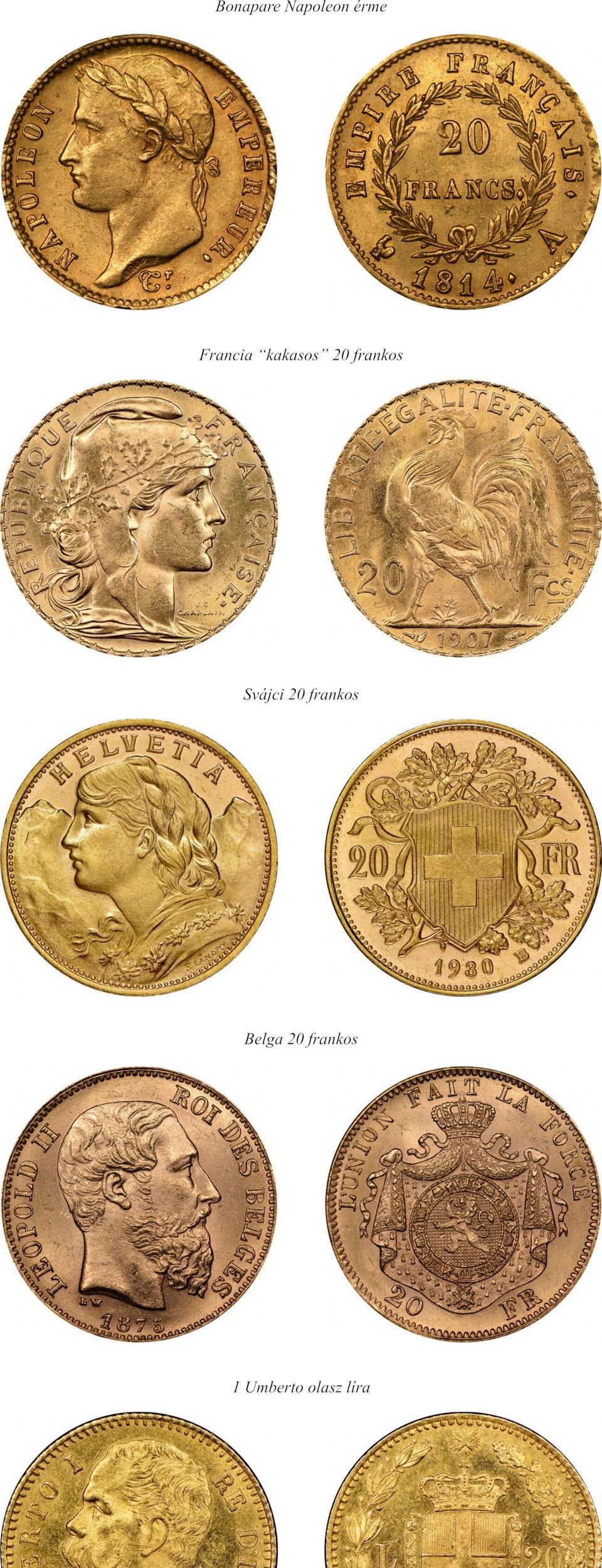
_A group of Latin Monetary Union coins_
In Hungary, during the Second World War and the subsequent currency crisis, which produced the worst hyperinflation the world has ever seen, the gold necklace link and the Napoleon III 20-franc gold coin, known locally as the "lajos arany" (Louis gold), briefly served as a medium of exchange. Large numbers of these coins remain in private hands across Central Europe to this day.
In Austria and Hungary, the former gold coins of the Austro-Hungarian Monarchy remain popular to this day. These 10 and 20-crown pieces contained slightly more gold than the 20-franc coins, so they could not be exchanged one-for-one for French francs. A few rare date variants already fall into the domain of numismatics, but the majority of 10 and 20-crown coins can be purchased at only a small margin above the world market gold price and are therefore considered investment gold coins.
An oddity is the Hungarian 100-crown gold coin. The Hungarian National Bank reused the original 1908-dated dies and struck a significant one-off quantity during the 1970s. As a result, these so-called "Artex" 100-crown coins can also be purchased at a low premium, even though the original (non-restrike) 100-crown coins belong to the rare numismatic category and trade at 3 to 4 times the gold price.
Other popular gold coins of Central Europe
On the Central European gold market, the British sovereign, the Dutch gulden and the German gold mark also appear in larger quantities among older coins. When a gold dealer purchases significant volumes of such old coins, they tend to pass them on quickly with a markup of just a few percent. Consequently, these gold coins can sometimes be acquired at surprisingly favourable premiums from larger gold dealers.
The most popular investment gold restrikes from Central Europe
The Austrian Mint (Münze Österreich) has achieved notable success with the re-minting of historic coins. The old 1-ducat, 4-ducat, 4 and 8-florin, and 20-crown coins find large numbers of buyers across the former Austro-Hungarian Monarchy, and therefore circulate on the secondary market at quite low premiums, making them typical investment gold coins. The ducats are struck by Münze Österreich at 986 millesimal fineness (23-carat gold) with the year 1915, and these gold coins are among today's most popular restrikes, particularly in the former Yugoslavia.
Modern investment gold coins
The modern investment gold coin era was inaugurated by the Krugerrand in 1967. The South African coin was designed as a genuine hard currency that could also be used in circulation. The Krugerrand followed British minting traditions and is therefore 22-carat, alloyed with copper for greater hardness. Like every 1-ounce investment gold coin, the Krugerrand contains exactly 31.103 grams of fine gold. The Australian Perth Mint entered the investment gold coin market with the Nugget and later the Kangaroo, the Canadian Royal Mint with the Maple Leaf, and Münze Österreich with the Vienna Philharmonic gold coin. The United States Mint introduced the American Eagle (also known as the Gold Eagle), a modern redesign of the Liberty $20 gold piece, followed by the American Buffalo, a fine gold investment coin. This established the investment gold product range that has dominated the investment gold coin market ever since. These coins are struck in such large quantities that their price is determined solely by the gold price, the mint's production costs, and the dealer's margin. The 1-ounce gold coins contain exactly 31.103 grams of fine gold. Apart from the Krugerrand and the Gold Eagle, which are alloyed, all other coins are four-nines (999.9) fine gold.
Alongside the 1-ounce investment gold coins, smaller coins are minted under each major brand name. The investment coin range typically starts at 1/20 or 1/10 of an ounce and goes up to 1 ounce. The Kangaroo is an exception in this regard, as a 1,000-gram investment gold coin is also produced in this series.
Modern investment gold coins with numismatic value
There are certain investment gold coins produced in smaller series whose premiums have risen significantly due to strong global demand. The most popular in this category is the Lunar series produced by the Australian Perth Mint. Two series of Lunar coins have been released so far, totalling 24 pieces (2 x 12). Some 1-ounce coins now trade on the secondary market at a 70% premium to the gold price (for example, the Lunar II Tiger). The Perth Mint issues the Lunar coins at the standard investment gold coin premium, making it particularly noteworthy that such a high premium has developed for a few extremely popular gold coins.
The Chinese Panda series also falls partly into this category, with the distinction that the Panda is now minted at 30 grams rather than the former 31.103 grams. However, the mint premium is a few percent higher than for the highest-volume investment gold coins. For Panda coins of 50 grams and above, sold in presentation cases, the mint margin is already quite high, placing them more in the numismatic domain than the investment gold category.

