


Security & Storage · Chapter 17
Gold Investment - Gold Fraud Schemes and Scandals

A detailed close-up of gold yuanbao objects, evoking the symbol of wealth and success in Chinese culture.
Learn about the most notorious fraud cases that caused billions of forints in losses for unsuspecting gold buyers, and draw lessons from them.
Abuse of gold dealers' names - The "false representative trick"
False representatives exploit the names of legitimate gold trading companies. The method works as follows: fraudsters use forged letterhead and business cards to sell, for example, gold savings schemes while posing as agents of a given company. The goal is to extract money from deceived customers, who are typically elderly. The fraudsters are usually caught relatively quickly, as the customer eventually contacts the company to enquire about their non-existent gold savings. A complaint follows, but the typical amounts involved are low enough that pursuing the matter in court may not be worthwhile. The simplest way for a prospective customer to detect this type of fraud is to ask the agent for their personal identification and then call the company to confirm whether the individual is under contract.
The "cheap gold trick"
This is the most difficult to detect and perhaps the most dangerous type of fraud. The fraudsters establish a fully legitimate gold trading company, complete with an attractive website, a serious marketing campaign, warehouse stock, and employees. They begin offering gold at or slightly below the wholesale price. They remain on the market for an extended period, sometimes 1-2 years, building trust. Because of their persistently low prices, an ever-larger share of the market's turnover shifts to them. The only conspicuous detail about their operation is that their business model is unsustainable; due to the aggressive price competition, their margin is zero, and they characteristically operate "at a slight loss." However, only industry insiders can identify this.
Then delivery times grow increasingly longer, and eventually "something happens" and the company shuts down overnight, typically at a point when it holds a substantial amount of client funds or gold.
The largest known case of this method in Hungary affected several hundred customers, totalling nearly half a billion forints.
The "trumpet brass" scandal
The largest gold scandal in Hungary, and quite possibly in all of Europe, was the "trumpet brass" case. Because several banks were involved but few private customers, the case is well documented. It was primarily a document forgery case rather than gold counterfeiting per se, not least because alloying gold with copper produces counterfeits that are easily detected through non-destructive testing. Nevertheless, the scandal damaged the reputation of Hungarian gold trading and likely undermined investor willingness to purchase gold, given the significant media coverage it received.
The "compound trick", or the gold pyramid scheme
Does gold pay interest? Physical gold held in a safe does not generate interest by its nature. Despite this, some operators advertise that they will pay interest on gold deposited with them. What actually happens is that they do not store the gold; instead, they sell it and "reinvest" the proceeds, attempting to pay the deposit interest from the returns. In reality, this has nothing to do with gold. Gold is merely used as a cover for deposit collection or for building a pyramid scheme. This activity is illegal, and it is always advisable to enquire with or report it to the MNB (National Bank of Hungary).
This type of fraud operates at a low intensity on an ongoing basis. However, when gold receives heightened media attention, such as during financial crises, the "pyramid builders" shift into higher gear.
Can I lend my gold for interest?
A retail gold lending market does not exist in Hungary. Lending gold is essentially the same as lending money, because the borrower most likely intends to sell it, for example to pay off a debt.
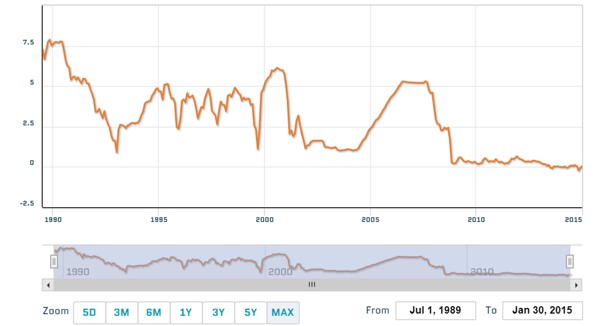
_Source: quandl_
International investment banks and central banks do enter into gold lending agreements among themselves. This institutional market, however, is not open to smaller clients. The institutional gold lending rate has hovered near 0% for close to a decade, and quotation of the so-called GOFO (Gold Forward Offered Rate) was discontinued in 2015.

