


Knowledge Base & FAQ · Chapter 22
Gold Investment - Key Concepts Related to Buying Gold

One of the most popular investment gold products is the 50x1 gram Valcambi Combibar, which can be broken apart gram by gram and sold individually
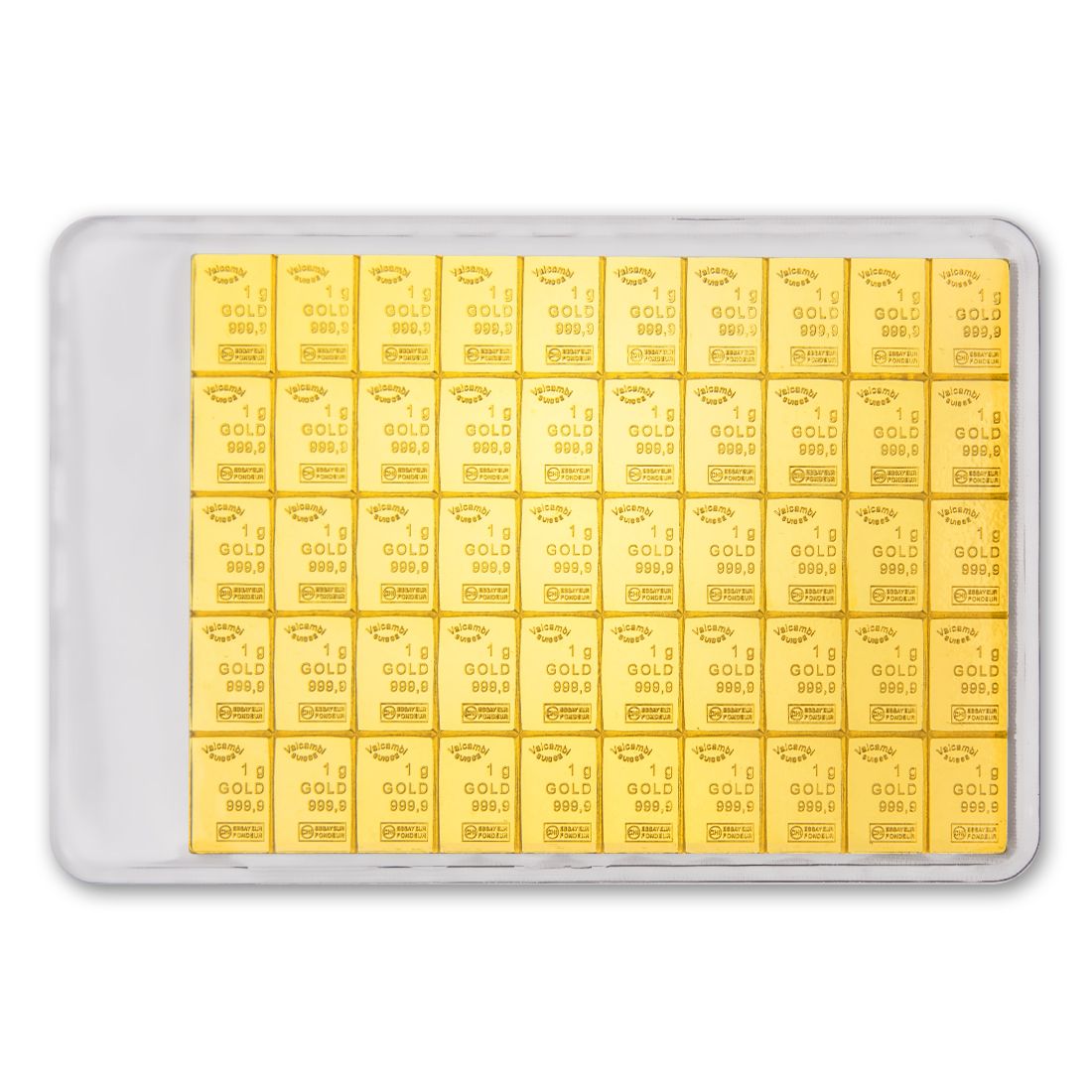
_One of the most popular investment gold products is the 50x1 gram Valcambi Combibar, which can be broken apart gram by gram and sold individually_
Key concepts and essential information related to buying gold, beginning with the weight, purity and criteria of investment gold. An overview of the Good Delivery standard, the information displayed on gold bars, ingots and coins, and the certificates issued by manufacturers.
How many grams is one troy ounce of gold?
One troy ounce of gold contains 31.103 grams of fine gold. Certain gold coins are alloyed with other materials (copper, silver) in addition to fine gold; in such cases the gross weight of the coin exceeds one ounce, but its fine gold content is always 31.103 grams.
What karat is investment gold?
Investment gold bars and fine gold coins are typically made from 24-karat fine gold. Alloyed gold coins may be made from 23.66-karat gold (986 millesimal fineness, e.g. ducat restrikes), 22-karat gold (916 millesimal fineness, e.g. the American Gold Eagle, the South African Krugerrand), or 21.6-karat gold (900 millesimal fineness, e.g. the 20-crown, the 20-franc Louis d'or, the Helvetia-Vreneli).
How is karat calculated for gold?
Fine gold is rated as 24 karat. If you multiply 24 by the coin's fineness (that is, the percentage of gold it contains), you obtain the karat figure from which the given investment gold product is made. In practice, however, the karat number is rarely used; instead, the coin's fineness is expressed in millesimal terms (for example, one would say "916-fineness gold coin" rather than "22-karat gold coin").
Since gold coins are rarely used as currency nowadays, there is no need to increase their hardness with alloying materials. For this reason, the majority of newly minted investment gold coins are fine gold, that is, 24-karat gold.
What does four nines fineness (0.9999) mean?
The majority of investment gold today is four nines fine. Four nines fineness means that the gold may contain no more than 1 ten-thousandth of impurities besides gold. This equates to 99.99% pure gold. With current refinery technology, producing gold of even higher purity is not cost-effective, as the expense of additional purification exceeds the value of the extra gold recovered. In laboratory conditions, however, it is possible to produce gold of even greater purity.
Is there three nines or five nines fineness gold?
Yes, there are coins struck from three nines (999 millesimal, i.e. 99.9%) fineness gold, for example the Chinese Panda coin.
Since 2014, the Royal Canadian Mint has also been producing five nines fineness (99.999%) coins in the Call of the Wild series. Purification above four nines fineness has essentially only marketing value, because even when buying 1 kilogram of gold, the difference in gold content amounts to just 0.09 grams, which at a gram price of ten thousand forints represents only HUF 900.
Although 1 kg of three nines gold should theoretically be approximately HUF 9,000 cheaper than 1 kg of four nines gold, a kilogram's worth of three nines Panda coins is nevertheless more expensive than a kilogram's worth of four nines Kangaroo coins, because the mint sells them at a higher price.
What does the Good Delivery standard mean?
The term Good Delivery gold bar refers to a gold bar of a quality acceptable for delivery. The London Bullion Market Association determines which manufacturers' bars may be delivered to the London precious metals market. Delivery most commonly takes place in 400-ounce gold bars. Manufacturers on the Good Delivery list are continuously monitored by the London Bullion Market Association. Strict dimensional and quality standards apply to the gold bars produced. The Good Delivery list is also known as the Gold List: it contains the manufacturers authorised to deliver to the London precious metals market. For more detail, see our article dedicated specifically to the Good Delivery standard.
What information is visible on the surface of a gold bar?
All essential information about the bar is engraved on the surface of a gold bar, including the gold's fineness, the product's weight, the manufacturer's logo, the bar's serial number, and in some cases the logo of the company that commissioned the bar from the manufacturer.
Older bars may lack a serial number, but such bars remain sellable because the dealer can exchange them for new bars upon payment of the difference.
Can anyone commission gold bars?
In theory yes, but in practice the minimum production order is so large that only major international banks and companies generating extraordinary turnover commission bars under their own brand. Most gold bars are brought to market by the manufacturers themselves.
Among Hungarian companies, BAV commissions bars from the Argor refinery in Switzerland under its own brand, but distributes them only through its own shops, since other gold dealers prefer to sell products bearing the Münze Österreich or Argor logos. In the case of buyback, however, BAV-Argor bars are also tradeable; any gold dealer will purchase them because they can be sold to jewellery manufacturers and goldsmiths, or exchanged for other gold bars.
Are certificates provided when purchasing gold?
Certificates are included by the manufacturers alongside the gold bar and contain information about the bar's properties as well as the manufacturer. Smaller gold wafers (up to 100 grams) are typically sold in credit-card-style packaging. For larger gold bars and ingots, a separate paper certificate is provided.
Not every gold bar comes with a certificate; for example, the Münze Österreich-type bars over 250 grams manufactured by Argor-Heraeus, the most widely available Swiss producer in Hungary, do not include one. The reason is that dealers examine the gold bar itself rather than the certificate, while if the certificate becomes detached, the bar can only be purchased at a slight discount.
In this sense, a gold bar originally sold without a certificate is actually easier to handle during buyback.

